
How to Choose the Best Education Path for Your Child with Special Needs
By: Lydia Chan
For parents of children with special needs, choosing a school or program can feel like a constant series of high-stakes calls with no perfect option. The tension is real: families are asked to make special needs education decisions while needs change, resources vary by setting, and advice can conflict. Everyday education challenges for special needs, support in the classroom, social fit, communication, and consistency, can turn “school choice” into a draining, emotional task. What helps most is getting clear on the options and the questions that bring the right information to the surface.
Quick Summary: Choosing the Right Education Path
● Start by clarifying your child’s strengths, needs, and learning goals.
● Compare education options by the supports, services, and accommodations each can reliably provide.
● Ask clear questions and review plans to confirm how progress will be measured and adjusted.
● Partner with educators and specialists to build a coordinated, realistic path forward.
● Revisit the placement over time and change course when your child’s needs evolve.
Understanding the Main Education Pathways
Inclusive education centers on your child learning in general classrooms with peers, with supports added so they can participate fully. Research describes inclusive education as the inclusion of all children with disabilities or special learning needs. Special education programs provide more specialized instruction, while private special needs schools offer a dedicated setting, and homeschooling lets you tailor pace, environment, and therapies day to day.
Why this matters is simple: each pathway solves a different problem. The right match can improve learning, behavior, and confidence while reducing daily stress at drop-off, homework time, and social activities. Picture a child who thrives socially but needs reading help. In an inclusive classroom, they might get targeted support and still join group projects, since inclusion means learning side-by-side across school activities. Another child may focus better in a smaller, highly structured program.
Special Needs Education Options at a Glance
This table compares the most common education pathways so you can match setting, supports, and daily demands to your child’s needs. It matters because the “best” choice is usually the one that reduces barriers to learning while staying workable for your family’s schedule and capacity. Many families use public support since 7.6 million students ages 3 to 21 receive special education services in the U.S
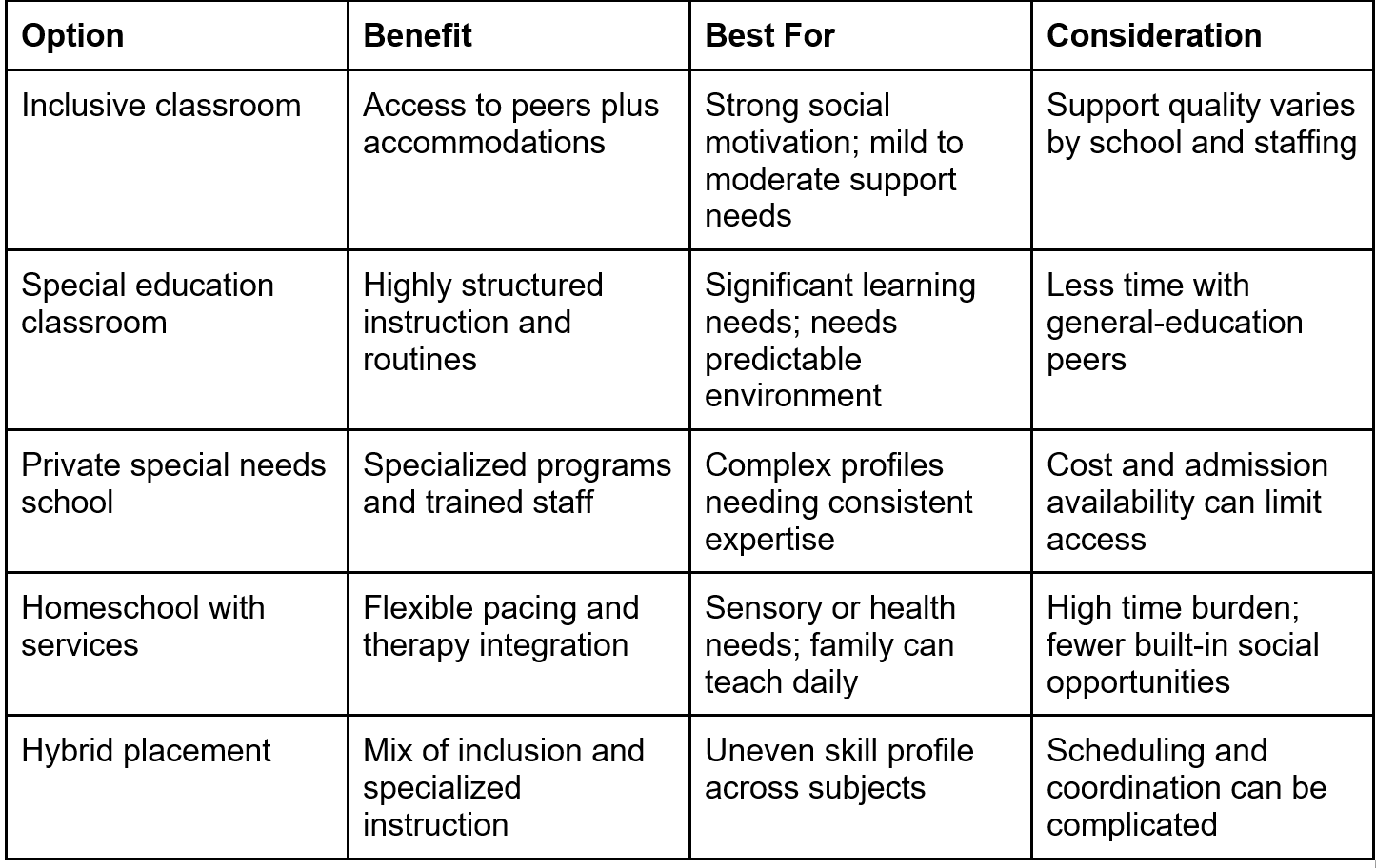
Use the “Best For” column to start, then check whether the consideration is a manageable tradeoff for your household. If two options fit, choose the one with clearer supports and easier communication. Knowing which option fits best makes your next move clear.
Common Questions Parents Ask When Choosing a Path
Q: How can parents identify the unique needs of their child to make informed decisions?
A: Start with a simple profile: strengths, biggest learning barriers, sensory needs, communication, and what helps your child recover after stress. Request or review evaluations and classroom data, then translate findings into needs statements like “needs visual schedules” or “needs reduced writing load.” If your child has an Individualized Education Program, use it as a snapshot of what supports are expected and why.
Q: What strategies can help reduce overwhelm when choosing the right path for a child with special needs?
A: Pick your top three “non negotiables” first, such as safety, communication support, or predictable routines. Then limit comparisons to those items and schedule one school tour or call at a time. Keep notes in one place so decisions are based on patterns, not last week’s stress.
Q: How do parents manage feelings of uncertainty or doubt during this decision-making process?
A: Treat doubt as information, not failure, and write down what specifically worries you. Ask the school how progress will be measured and how often you will get updates, since clarity reduces spiraling. Remind yourself that placements can be adjusted when new data shows a better fit.
Q: What resources or tools can simplify the process of selecting a suitable option for their child?
A: Use a one page checklist for what you want to observe: instruction style, behavior supports, and how accommodations show up during a typical lesson. For paperwork, create a single shareable folder or one PDF that includes evaluations, prior IEPs, notes from providers, and your parent concerns letter; if you're exploring how to combine PDF documents, this helps the team review faster and reduces back and forth requests.
Q: How can a specialized service help parents explore different support options tailored to their child's needs?
A: A specialized service can help you interpret evaluations, turn them into practical school supports, and map those supports to realistic placements. They can also coach you on IEP meeting preparation and timelines, since an IEP is a legal document that guides services and accountability. With guided options, you can choose based on fit and feasibility rather than fear.
Make a Confident Special Needs Education Choice with Support
Choosing a school or program for a child with special needs can feel like high-stakes guesswork, especially when paperwork and opinions pile up. A steady, family-centered approach, clarifying goals, using evaluations and the IEP process, and comparing options against real needs, offers a summary of education guidance that cuts through the noise and keeps decisions grounded. With that mindset, empowering parents in special needs education becomes practical: decisions are documented, discussions stay focused, and building confidence in education choices gets easier over time. The best education path is the one that fits your child and can be supported consistently.