
A Guide to Starting and Growing a Business as an Entrepreneur with a Disability
By: Lydia Chan
For first-time entrepreneurs with disabilities who want real disability and business ownership, the biggest hurdle is often that the rules of business were built without them in mind. The challenges for disabled founders can include unpredictable health needs, inaccessible spaces or systems, and skepticism from partners, customers, or even support programs. Yet disability-inclusive entrepreneurship is also a practical way to create work that fits actual lives, opening doors to accessible business opportunities that reflect what communities are missing. With the right expectations and a clear focus, ownership can be built on strengths that others overlook.
Quick Summary: Starting a Business with a Disability
● Define your business idea and plan early so you can launch with clear direction.
● Identify needed disability accommodations and build them into your daily operations.
● Choose tools, workflows, and spaces that support accessibility and reduce unnecessary
barriers.
● Apply inclusive strategies that help you serve customers well and grow sustainably.
Understanding Fit: Strengths, Access, and Skill Building
To make smart choices, start by matching a business idea to your strengths and your access needs. Then compare simple business structures, like sole proprietorship or LLC, so you know what paperwork, risk, and support you are taking on. Because entrepreneurship is twice as popular amongst disabled people than their non-disabled counterparts, building a plan that fits you can be a real advantage.
This matters because the right fit reduces daily friction and saves energy for customers and revenue. It also clarifies what to learn first, so you do not spend money on tools or training you will not use.
Think of it like fitting a bike: the frame is your business structure, and the seat height is your accessibility setup. A short, structured course or even pursuing business administration degrees can be the practice laps that sharpen pricing, marketing, and budgeting before you ride on busy roads.
Plan → Test → Fund → Launch → Review
To keep your business moving without burning through energy, use a short cycle you can repeat weekly. This workflow turns big goals into small, accessible actions so you can validate demand, secure support, and improve your systems as you grow.
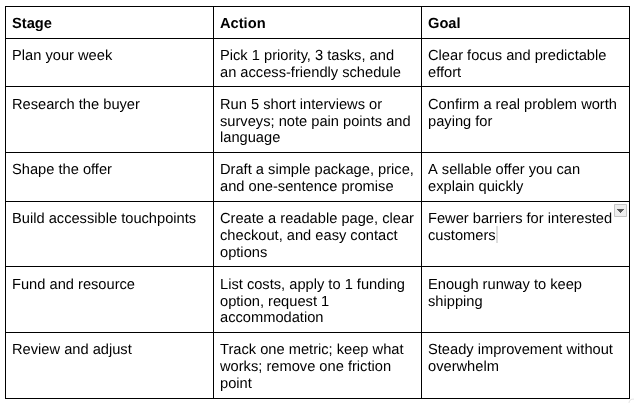
These stages reinforce each other: research sharpens your offer, your offer drives what you build, and funding supports consistent delivery. Accessibility stays “on” throughout, especially since many shoppers know what areas are accessible when deciding where to buy.
Habits That Protect Energy and Grow Your Business
Habits turn good intentions into automatic progress, especially when energy and access needs vary day to day. Use these routines to keep your business moving, reduce decision fatigue, and build confidence through consistent, manageable wins.
Daily Top-3 and Stop Time
● What it is: Write 3 must-do tasks and one firm stop time.
● How often: Daily
● Why it helps: It prevents overcommitting and protects recovery time.
Micro-Offer Rehearsal
● What it is: Practice your one-sentence promise out loud, then refine one word.
● How often: 3 times weekly
● Why it helps: You explain value faster in emails, calls, and pages.
Flexible Daily Checklist
● What it is: Keep 3 to 5 repeatable actions you can finish anytime.
● How often: Daily
● Why it helps: Consistency stays possible on flare-up or appointment days.
Tech Assist Audit
● What it is: Pick one tool that can solve practical problems and set it up.
● How often: Weekly
● Why it helps: Small automations reduce effort and improve reliability.
Access and Boundaries Note
● What it is: Write one accommodation need and one boundary for the week.
● How often: Weekly
● Why it helps: Clear requests prevent friction and support sustainable output.
Build Business Confidence by Taking One Real Step Now
Starting a business while managing a disability can feel like carrying two full-time jobs, especially when energy, access, and uncertainty stack up. The steadier path is the one built on entrepreneurial confidence, realistic planning, and supportive systems that treat obstacles as solvable problems rather than personal limits. When that mindset guides decisions, taking action in entrepreneurship becomes simpler, momentum grows, and business startup motivation lasts beyond the first burst of excitement. Barriers are real, but they’re problems to design around, not reasons to stop.